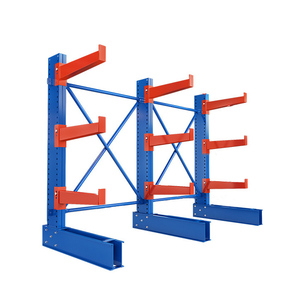
 Timber Storage
Direct Manufacturer · 35,000 m² Automated Plant · 60+ Countries
China Wholesale Cantilever Racking Wholesaler & Wholesalers
Factory-direct single and double-sided cantilever racking for pipe, lumber, profiles and irregular loads — engineered to EN 15512, hot-dip galvanised or powder coated, and shipped worldwide with a 5-year warranty.
Get Catalog
Wholesale Product Range
Eight Cantilever Racking Configurations Ready for Export
Every unit below is produced on the same robotic welding and laser-controlled roll-forming lines and carries the same 5-year warranty. Choose a standard configuration for fast delivery, or send your load schedule and our structural engineers will return a dedicated frame-and-arm combination within five working days.
Timber Storage
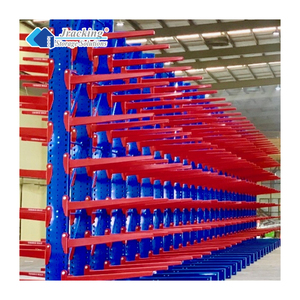 Cold Pipe
CE-Certified Heavy-Duty Cantilever Racking System for Cold Storage Pipe
View product →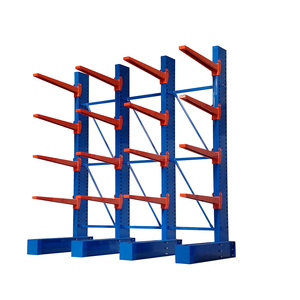 Pipe & Lumber
Steel Structural Pipe Rack Cantilever Rack for Pipe and Lumber Storage
View product →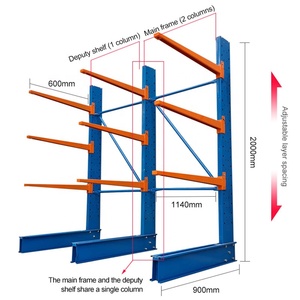 Customized
 Powder-Coated Indoor Heavy-Duty Cantilever Shelving Racking
View product →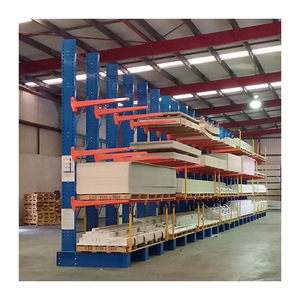 Corrosion Protected
Adjustable Corrosion-Protected Steel Pipe Cantilever Rack System
View product →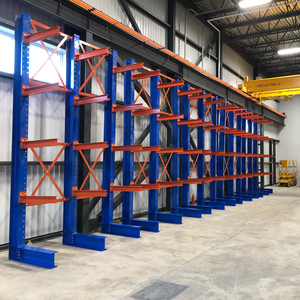 Irregular Goods
Heavy-Duty Adjustable Cantilever Rack for Irregular Goods Indoor and Outdoor
View product →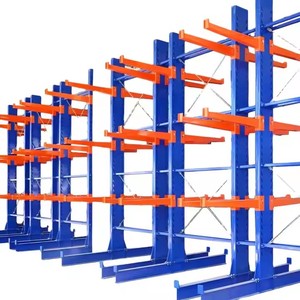 OEM / ODM
Galvanized Heavy-Duty OEM ODM Cantilever Rack for Warehouse Tube Storage
View product →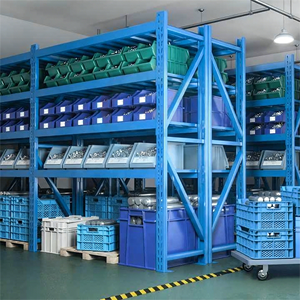 Light Duty
Durable Boltless Adjustable Light-Duty Industrial Metal Shelving and Storage Racks
View product →60+
Countries with installed cantilever and pallet racking
14
Own branches supporting export projects
70+
Trusted distributors and integration partners
90%
Of annual production exported worldwide
Product Fundamentals
What Is Cantilever Racking — and When Should It Replace Pallet Racking?
Cantilever racking is a long-load storage system built from a vertical column, a heavy welded base, and horizontal arms that project into the aisle without any front upright. Because the front of the rack is completely open, a six-metre bundle of steel pipe, a stack of four-metre timber boards or an extruded aluminium profile can be loaded and retrieved in a single forklift movement — no threading between uprights, no catching the load on a frame, no damaged stock.
The structural logic is simple: the column carries the bending moment, the base resists overturning, and the arm carries the load. That is why a properly engineered cantilever bay can carry substantially more weight per linear metre than a selective pallet rack of the same footprint, while allowing unrestricted access along the full length of the stored material.
Selective pallet racking remains the right answer for cube-shaped, palletised goods with a high SKU count. Cantilever racking trades pallet density for unrestricted length access, and it wins whenever the load is longer than the handling equipment is wide. In practice, most yards handling steel, timber, plastics or composite profiles end up running both systems side by side — pallet racking for boxed consumables and cantilever for the long material store.
Steel pipe & tube bundles
Sawn timber & lumber
Aluminium extrusions
Sheet, panel & board goods
HDPE, PVC & composite profiles
Coils with saddle arms
Specification Guide
Six Variables That Decide Price, Safety and Lead Time
Buyers who understand these six inputs stop comparing quotes on steel weight alone — and start comparing quotes on total cost of ownership.
1. Load per Arm
The single biggest cost driver. A 500 kg arm uses a lighter cold-formed profile than a 3,000 kg arm, and specifying 3,000 kg for a 600 kg load can double the steel weight and the freight bill.
2. Column Height
Columns are produced in standard 3 m to 6 m lengths. Every extra metre changes the base plate and the anchor design, because overturning moment grows with the square of the height.
3. Arm Length and Pitch
Arm pitch is the vertical distance between levels and is set by the height of your load. A 300 mm pitch suits steel bar; a 1,200 mm pitch suits timber packs. Standardising pitch across a yard reduces spare-part inventory.
4. Single or Double Sided
Double-sided units share one column and halve the aisle count, but they require access from both sides. Single-sided units suit wall placement and outdoor yards where a forklift approaches from one direction only.
5. Base Plate and Anchorage
Base size and anchor specification are dictated by load moment, concrete strength and seismic demand. A 150 mm slab is rarely sufficient for tall cantilever columns; chemical anchors or through-bolts with a documented pull-out value are usually required.
6. Surface Finish
Powder coating suits indoor warehouses. Outdoor yards and cold stores need hot-dip galvanising to EN ISO 1461, often with a duplex topcoat, to reach ISO 12944 C4 or C5 corrosion life.
Load Reference
Cantilever Racking Load Classes at a Glance
Use these bands as an early-stage procurement reference. Final arm and column sections are always recalculated for your exact load, span and code requirements.
Class 1
Light Duty
150–400 kg per arm. PVC conduit, small aluminium profiles, light furniture panels. Typical column spacing 1,000–1,500 mm.
Class 2
Medium Duty
400–1,000 kg per arm. Aluminium extrusions, sawn timber, plastic sheet. Typical column spacing 1,200–1,800 mm.
Class 3
Heavy Duty
1,000–2,500 kg per arm. Steel pipe and tube bundles, structural sections. Typical column spacing 1,500–2,400 mm.
Class 4
Extra Heavy
2,500–5,000+ kg per arm. Solid steel bar, heavy rolled sections, coil saddles. Typical column spacing 2,000–3,000 mm.
Market Outlook
Cantilever Racking Procurement Trends 2026–2030
Six shifts our export team is seeing in tender documents from distributors, steel service centres and 3PL operators across Europe, the Gulf, Latin America and Southeast Asia.
Framework agreements replace one-off orders
Large distributors increasingly buy against a 12–24 month framework rather than project by project. The evaluation shifts from unit price to reserved capacity, fixed lead times and price-index clauses tied to hot-rolled coil.
Seismic and wind loads enter the tender
Ten years ago a cantilever enquiry arrived as a drawing and a load figure. Today a growing share of enquiries from Chile, Peru, Turkey and Indonesia include the local seismic code, the site soil class and a wind speed map for outdoor yards. Suppliers who cannot issue a signed calculation package are filtered out early.
Corrosion is specified by environment class
Buyers are moving from “galvanised or painted” to ISO 12944 classes — C3 for a covered inland warehouse, C4 for a coastal yard, C5-M for offshore and chemical plants. Hot-dip galvanising plus a duplex powder topcoat is now the default for humid outdoor yards.
Container-optimised engineering cuts landed cost
Freight can be 15–25% of the landed cost of a cantilever order. Wholesalers now demand a 40HQ loading plan before approving a design: nested columns, arms packed inside the column cavity, base plates stacked flat. A well-engineered 40HQ carries 22–26 t of components.
OEM and private-label programmes are growing
Distributors want the rack to carry their own brand, manual and warranty document. A mature China wholesaler supports this with neutral packing, controlled artwork and serial-number traceability that the distributor can query by batch.
Documentation becomes part of the product
Carbon footprint declarations, EN 10204 3.1 material certificates, welding documentation to ISO 3834-2 and IFC/BIM models are now requested alongside the rack — particularly on projects financed by development banks or occupied by multinational tenants.
Technology Roadmap
Where Cantilever Racking Technology Is Heading
Four engineering directions that will separate competitive wholesale suppliers from commodity sellers over the next five years.
Higher-strength steel, lighter frames
Q355B (S355JR) is replacing Q235B in columns and arms. The higher yield strength cuts steel weight by 8–15% at identical capacity, which directly reduces container freight per bay.
Duplex coating systems
Hot-dip galvanising plus a powder topcoat now delivers C4–C5 corrosion life beyond 25 years, which is becoming a tender requirement for port yards and coastal plants.
Tool-free arm adjustment
Boltless pin-and-socket arm connections on 50 mm pitch let warehouse staff re-level a bay in under a minute, without a fitter visit — a major advantage for yards with changing product mixes.
Digital twin deliverables
IFC models, QR-coded load labels and WMS-readable location codes are increasingly shipped with the rack, so that commissioning and future expansion do not require a site survey.
Manufacturer Advantages
Why Global Distributors Buy From a Single China Cantilever Racking Wholesaler
Alohatop Shelf LLC is not a trading company reselling another factory's frames. We design, calculate, manufacture and install metal racking from a 35,000 m² production centre with more than 100,000 t of annual steel capacity — and more than 90% of that output leaves the country.
35,000 m²Highly automated production centre
100,000 tAnnual steel processing capacity
42,000+Warehouse projects delivered
5-YearWarranty on every storage system
Automated production, not manual welding
Robotic welding cells and laser-controlled roll forming keep every frame and arm inside the tolerances that AS/RS integrators and safety auditors require, and they hold those tolerances across large-volume repeat orders.
University-backed structural R&D
Our technology centre runs laboratory testing with Mondragon University and a simulation chair with the University of the Basque Country, covering frame behaviour, base connections and cyclic loading under seismic demand.
Full component traceability
Every upright, beam and arm is traceable from steel batch to installation sign-off. If an auditor asks for the material certificate behind a specific column, we retrieve it from the production record, not from memory.
Export logistics built in
More than 90% of output is exported, with shipping experience to Santos, Callao, San Antonio, Cartagena, Antwerp, Jebel Ali and Singapore. A loading plan is issued with every quotation, not after the order.
Certified management systems
Quality, environmental, safety, energy, welding and structural steel certification are maintained continuously — with ISO 14064 verified carbon reporting available for buyers who need it in the tender pack.
OEM and private-label programme
Neutral or branded packaging, customer manuals, custom RAL colours, customer-specific load labels and a serial registry — so that the distributor owns the brand while we own the manufacturing risk.
Quality & Compliance
Certifications That De-Risk a Wholesale Order
Documentation is verified before shipment, not after arrival. Every certificate below is maintained under continuous third-party audit.
ISO 9001Quality management
ISO 14001Environmental management
ISO 45001Health & safety at work
ISO 50001Energy management
EN ISO 3834-2Welding quality control
EN 1090-1Structural steel components
ISO 14064Verified carbon footprint
Full TraceabilityBatch-to-installation records
Wholesale FAQ
Cantilever Racking Wholesale: Questions Buyers Ask Before Ordering
The six questions our export engineers answer most often, with the technical detail that procurement teams actually need.
What is the minimum order quantity (MOQ) for cantilever racking?
MOQ is driven by container economics rather than an arbitrary unit count. For standard powder-coated indoor systems we can ship a mixed container from roughly 8–12 single-sided bays, combined with other racking products if needed. For hot-dip galvanised or custom-colour systems a full 40HQ is normally the economic minimum, because the galvanising batch charge and the paint line setup are fixed costs that do not shrink with order size.
How long does production and ocean freight take?
Standard powder-coated cantilever racking ships 20–30 days after drawing approval. Hot-dip galvanised systems need 30–45 days because of the galvanising cycle and the additional inspection step. Ocean freight to Santos, Callao, Antwerp, Jebel Ali or Singapore typically adds 25–45 days depending on the route and the sailing schedule. We issue a production timeline with the quotation so that your project programme is based on real dates.
Can you design to my local seismic or wind code?
Yes. We routinely calculate to NCh2369 and NCh433 (Chile), E.030 (Peru), NSR-10 (Colombia), NEC (Ecuador), IBC and ASCE 7 (United States) and Eurocode 8. For outdoor cantilever yards we also check wind uplift on the column bases and, where relevant, snow accumulation on the arms. The calculation package is issued as a signed document that your structural engineer or building authority can review.
Straight arms or inclined arms — which should I choose?
Straight arms are better when the load must slide along the arm or when uniform bundles are stored at low height. Inclined arms, typically 3–5°, are the standard for pipes and lumber, because the load naturally settles against the column and cannot roll off. Many yards use inclined arms at the lower levels and straight arms higher up, where the forklift needs the extra clearance to place a bundle accurately.
Do you offer OEM, ODM and private-label programmes?
Yes. We manufacture under our customers' brands for distributors in more than 60 countries. The programme covers neutral or branded packaging, customer manuals, custom RAL colours, customer-specific load labels and a serial-number registry so that the distributor can trace any component back to its production batch. Artwork and manual approval happens before production starts, not after.
What information do you need to quote a cantilever racking project?
Send us the maximum load length, the maximum load weight per arm, the number of storage levels, the available height, whether the system is indoor or outdoor, the required surface finish, the destination port and any local code that applies. A hand sketch with dimensions is enough — our engineers will return a general arrangement drawing, a container loading plan and a price within five working days.
Start Your Project
Ready to Price Your Cantilever Racking Order?
Send your load schedule, destination port and any local code requirement. Our structural engineers will return a general arrangement drawing, a 40HQ loading plan and a factory-direct quotation within five working days.
Get Catalog